
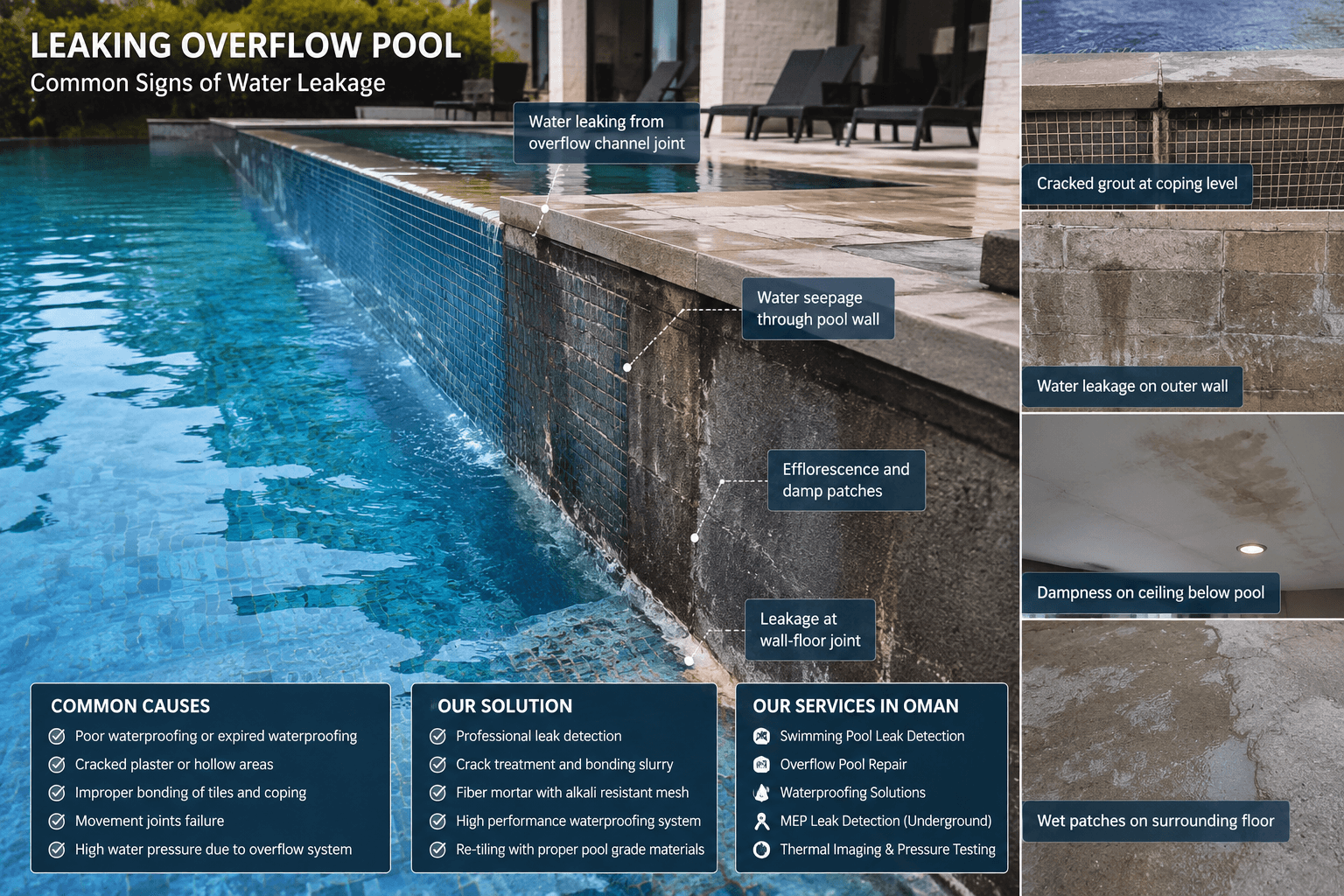
How to Detect Swimming Pool Leaks in Oman: Advanced Pool Leak Investigation, Overflow Pool Repair, Waterproofing & Structural Rehabilitation in Muscat and Across Oman. Swimming pool leakage is one of the most expensive and technically challenging problems faced by villa owners, hotels, resorts, commercial properties, and facility management companies in Oman. Many leaks are hidden behind tiles, inside underground pipe systems, beneath overflow channels, or within old, modified pool structures.

Pool Leak Detection & Structural Repair Services.
At our specialized pool engineering and leak detection division, we provide professional swimming pool leak investigation, pressure testing, structural assessment, waterproofing inspection, and advanced repair solutions for all types of swimming pools in Oman.
Water Tech has experience in:
- Swimming pool leak detection
- Overflow pool conversion inspection
- Structural crack investigation.
- Underground pipe leak testing.
- Waterproofing failure diagnosis.
- Pool shell inspection.
- Pool renovation technical consultation
- Pool pressure testing and certification
- Waterproofing rectification systems.
- MEP and pump room inspection.

We provide services for:
- Villas.
- Luxury residences,
- Hotels,
- Resorts,
- Commercial pools,
- Community pools,
- Roof-top pools,
- Water features and
- fountains,
- Spa and
- Jacuzzi systems
Why Swimming Pools Leak in Oman

Swimming pools in Oman are exposed to extreme environmental conditions, including:
- High temperatures
- Thermal expansion and contraction
- Ground movement
- Salt exposure near coastal areas
- Waterproofing deterioration
- Improper renovation work
- Poor bonding between old and new construction layers.
One of the most common problems we identify is leakage in modified pools that were originally designed as skimmer pools and later converted into overflow pools.
Common Pool Leak Problems We Detect
1. Overflow Pool Leakage
- Overflow pools maintain a constant high water level at the coping and gutter system. This creates continuous hydrostatic pressure at the upper wall zone.
Common leakage points include:
- Overflow channels
- Coping joints
- Wall-floor junctions
- Tile grout failures
- Waterproofing cracks
- Modified wall extensions
Many older pools were not originally designed for overflow operation. During conversion works, additional concrete layers, plaster systems, or block walls may be introduced without proper structural bonding or waterproofing. This often leads to:
- Hollow plaster areas
- Debonding
- Hidden seepage
- Efflorescence
- Structural deterioration

Underground Pipeline Leaks
Pool circulation pipelines are often buried underground and may develop leaks due to
- Pipe movement
- Joint failure
- Improper backfilling
- Material aging
- Pressure fluctuations
We use advanced testing methods, including:
- Hydrostatic pressure testing.
- Line isolation testing.
- Acoustic leak detection.
- Underground tracing.
- Thermal imaging.
- Water loss analysis.
- Borescope camera

Waterproofing Failure
Many swimming pools rely only on tiles and plaster for water resistance. However, tiles are not waterproofing systems.
Without proper waterproofing membranes, water gradually penetrates through the following:
- Grout joints
- Micro cracks
- Weak construction joints
- Pipe penetrations
Over time, this causes the following:
- Water seepage
- Structural damage
- Tile detachment
- Hollow sounds behind plaster
- Continuous water loss


