
How to Identify Structural Leaks in Your Pool? In Oman, swimming pool leakage is one of the most critical and costly defects in reinforced-concrete pool construction, especially when the structure is adjacent to basements, service corridors, or occupied areas.

Case Study: Swimming Pool Structural Leak Identification & Waterproofing Rectification.
Introduction
Swimming pool leakage is one of the most critical and costly defects in reinforced concrete pool construction, especially when the structure is located adjacent to basements, service corridors, or occupied areas. Poor concrete compaction, construction joint failure, honeycombing, and improperly sealed penetrations can lead to severe long-term seepage problems.
This case study explains the complete process of identifying, analyzing, repairing, and waterproofing a leaking reinforced concrete swimming pool structure using advanced crack repair and cementitious waterproofing systems under GCC climatic conditions.

Project Background
The project involved a reinforced concrete swimming pool that developed multiple leakage points immediately after initial water testing following RCC completion.
Initial Observations
The following defects were identified during inspection:.
- Water seepage through construction joints.
- Leakage around piping sleeves and electrical conduits.
- Multiple vertical wall cracks.
- Honeycombed concrete surfaces.
- Weak and porous concrete zones
- Improper compaction during concreting •
- Inadequate vibration during casting
- Temporary sleeve packing using cement bag paper
- Hollow sound detected behind repair plaster areas

Root Cause Analysis
After detailed visual inspection and hammer testing, the major causes were identified as:
1. Poor Concrete Compaction
Insufficient vibration during RCC casting resulted in:
- Honeycombing •
- Air voids
- Weak bonding zones

2. Improper Construction Joint Preparation
Cold joints between raft and wall sections created seepage paths under hydrostatic pressure.

3. Improper Penetration Sealing
Pipe sleeves and electrical conduits passing through the wall were inadequately sealed

4. Thermal and Shrinkage Cracking
High ambient temperatures combined with weak substrate conditions caused shrinkage movement and crack propagation.

Leak Detection & Structural Assessment
The following investigation methods were carried out:
- Visual crack mapping
- Hammer tapping test for hollow zones
- Water seepage monitoring
- Joint inspection
- Penetration inspection
- Surface preparation assessment
The inspection confirmed that the majority of leaks originated from:
- Construction joints
- Penetration areas
- Crack lines
- Honeycombed concrete zones
Structural Rectification Process
1. Surface Preparation
All weak concrete and loose particles were removed completely.
The structure was:
- cleaned thoroughly,
- dust-free,
- and prepared for repair works.
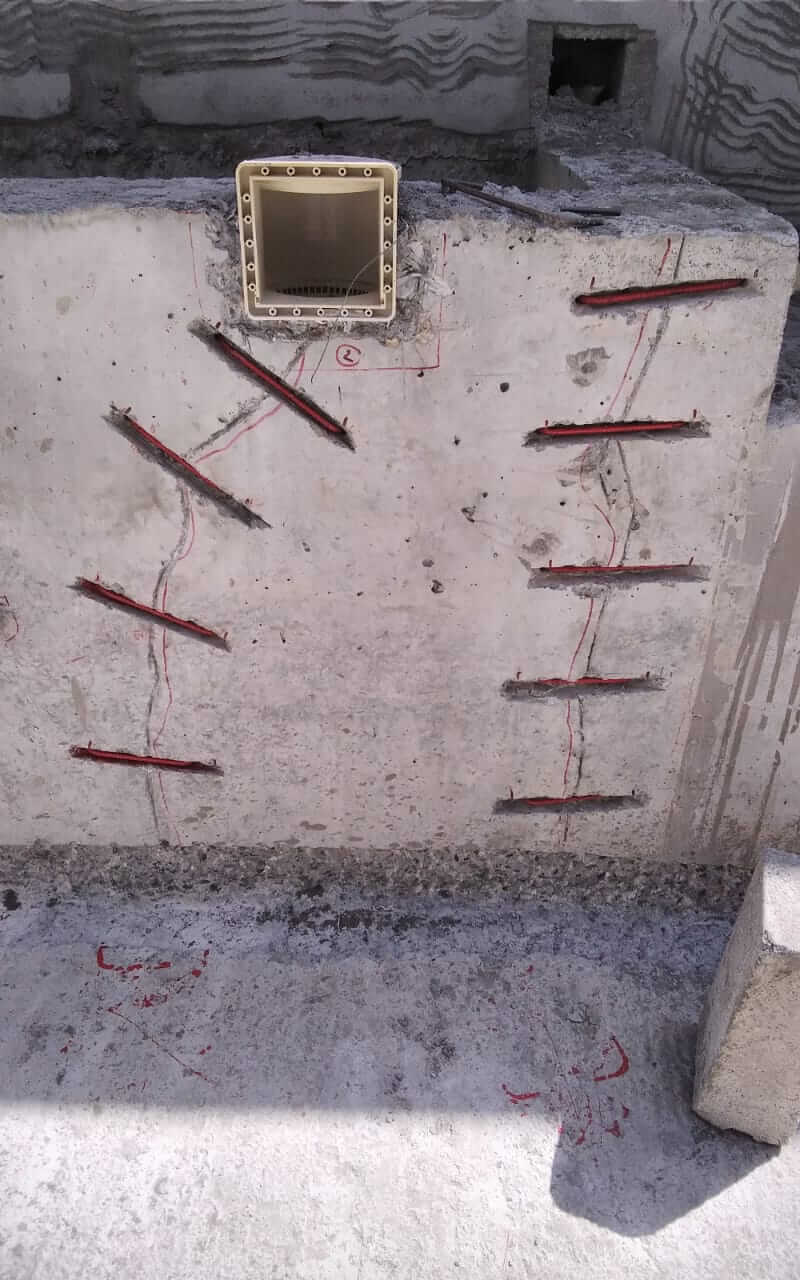
2. Crack Cutting & Stitching
All visible cracks were:
- cut into V-groove profiles,
- cleaned,
- and stitched using 10 mm steel reinforcement bars installed at regular intervals.
Anti-corrosion protection was applied to the reinforcement before sealing.
3. Epoxy Injection
Structural cracks and debonded zones were repaired using low-viscosity epoxy injection systems.
Materials Used
- Fosroc Nitofill EPLV
Injection was performed using low-pressure packer systems to restore the bond between the repair layers and the structural concrete.
4. Structural Repair Mortar Application
A 15 mm thick non-shrink fiber-reinforced thixotropic repair mortar layer was applied over prepared surfaces.
Materials Used
- MAPEI Groutme 60T
- SikaEmaco S 488
All wall-floor junctions and corners were converted from 90° edges into 45° fillet profiles to improve waterproofing continuity and stress distribution.
Crystalline Waterproofing System
After curing of the repair mortar, a crystalline cementitious waterproofing layer was applied.
Material Used
- Fosroc Brushbond TGP
This layer was used to:
- reduce porosity,
- block micro-capillaries,
- and improve resistance against water migration and chloride penetration.
Flexible Cementitious Waterproofing System
Following crystalline treatment, a reinforced waterproofing membrane system was installed.
Material Used
- SikaTop 107
Application Method
- First waterproofing coat
- Alkali-resistant fiberglass mesh embedding
- Second waterproofing coat
- Third waterproofing coat
Importance of Reinforcement Mesh
During site testing, areas without reinforcement mesh developed hairline cracks shortly after waterproofing application, while reinforced zones remained stable.
This confirmed the importance of:
- crack-bridging reinforcement,
- stress distribution,
- and movement control within repaired pool structures.
Curing Process
Due to GCC summer temperatures reaching approximately 40°C, a controlled curing process was implemented.
Curing Method
- Full pool coverage using polythene sheets
- Regular water mist spraying
- Moist curing is maintained for 10–14 days
Proper curing was critical to:
- reduce shrinkage cracking,
- improve hydration,
- and maximize waterproofing performance.
Final Inspection Before Filling
Before water filling:
- all joints,
- penetrations,
- repaired cracks,
- and waterproofed surfaces
were carefully inspected.
Localized touch-up coating was applied where required.
Water Filling & Monitoring Procedure
The pool was commissioned using a controlled filling process with continuous monitoring of:
- joints,
- conduits,
- repaired areas,
- and surrounding structural zones.
Special attention was given to:
- hydrostatic pressure response,
- seepage monitoring,
- and water level stability.
Key Lessons Learned
Proper Concrete Quality is Critical
Most long-term pool failures originate from:
- poor compaction,
- honeycombing,
- and improper joint detailing.
Penetrations Are High-Risk Areas
Pipe sleeves and electrical conduits require:
- engineered detailing,
- flexible sealing,
- and reinforced waterproofing.
Reinforced Waterproofing Performs Better
Mesh-reinforced cementitious waterproofing significantly reduced crack formation compared to coating-only applications.
Proper Curing Is Essential
In high-temperature GCC conditions, waterproofing systems require extended moist curing to prevent premature shrinkage and performance reduction.
Conclusion
This project demonstrates that even severely leaking reinforced concrete pools can be successfully rectified through:
- systematic structural assessment,
- proper crack injection,
- engineered repair mortars,
- crystalline waterproofing,
- reinforced cementitious membranes,
- and disciplined curing procedures.
A properly executed waterproofing rectification system not only stops leakage but also extends the long-term durability and service life of the swimming pool structure.
About Our Services
We provide professional:
- Swimming pool leak detection
- Structural waterproofing rectification
- Pool crack injection systems
- Basement seepage solutions
- Waterproofing consultancy
- MEP and pool engineering services
For professional consultation and inspection services, contact us for detailed assessment and rectification solutions tailored to your project conditions.


